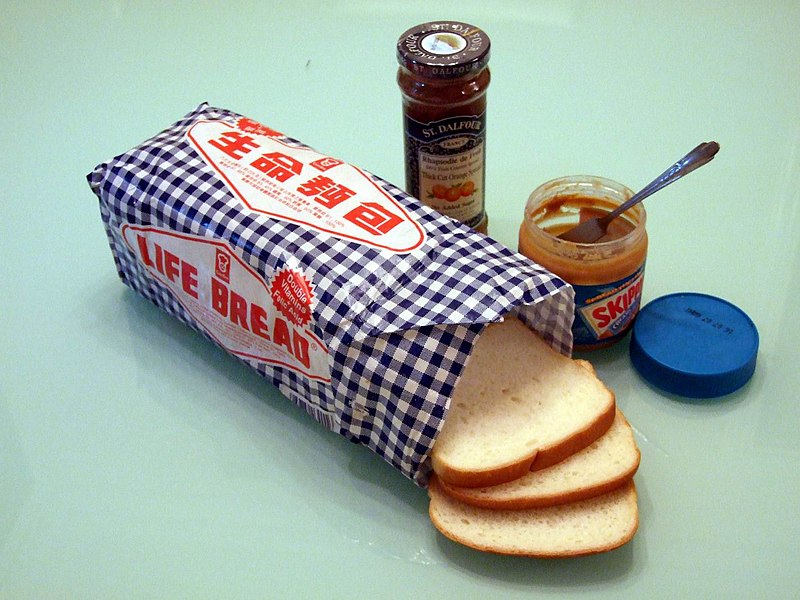
Chong Fat, Public domain, via Wikimedia Commons
Peanut butter and jelly sandwiches and peanut butter filled sweets are a staple in many people’s diets. Unbelievably, peanut butter is largely an American thing. Buying peanut butter in other countries, such as in Europe, is harder to find compared to American stores.
If it is found, it is often in smaller jars with less options. It is not typically associated with American culture in America, which is why it is such a surprise when Americans find out how tied the treat is to their country.
Peanut butter is a cultural staple of the country now, but it was not random, and it was pushed to become such an American treat intentionally in such strong ways that it holds on tightly to the culture.
There are many historical ties to peanut butter, as well as peanuts itself, in America. It started with George Washington Carver. George Washington Carver did not invent peanut butter, but his work helped jump start finding other ways to use peanuts and made them already profitable to grow in other ways.
Carver helped liberate Black farmers who were enslaved, as he helped combine “land exploitation and racial exploitation” (Wheeling). He discovered over three hundred ways to use peanut butter, and this helped out the black farmers because it freed them from having to continue to grow cotton as peanuts became more profitable due to his research and experiments. While he did not invent peanut butter, his contribution to the nut certainly helped set actions for the continued investigation of uses for peanuts.
John Harvey Kellogg, the same king of cereal, is credited as the closest thing to a founder of peanut butter itself despite controversial debates over who did.
He was a person who “endorsed a plant-based diet and promoted peanut butter as a healthy alternative to meat” and his employee, Joseph Lambert claimed that the treat at just the ten-cent amount “contained six times the energy of a porterhouse steak” (Wheeling). These words influenced the American people, including celebrities such as “President Warren G Harding, abolitionist and women’s rights activist Sojourner Truth, aviator Amelia Earheart, actor Johnny Weissmuler, and auto magnate Henry Ford” (Krampner 30).
In World War I, Americans assumingly listened to Kellogg and “turned to peanuts as a result of meat rationing” (Wheeling). Americans were eating peanut butter instead of meat, which contributed to a sense of patriotism caused by them following the advice of Kellogg and Lambert. It was their duty as Americans to ration meat, and peanut butter was a part of that.
Peanut butter being connected to the war efforts helped solidify its position as an American treat. Americans treat challenging times such as war times with patriotism, which is different than how the Europeans dealt with war tragedies in a more negative light, as it is theorized it doesn’t culturally stick because “American CARE packages included peanut butter” during World War II” (Krampner 136).
American history and issues continued to push the popularity of peanut butter products.
The Great Depression was a tough time for Americans following World War I. Many people lost their jobs, and they could not afford to feed themselves. Soup kitchens popped up with increased visitors to them frequently looking for a meal, and when they went, “peanut butter sandwiches were handed out in food lines” (Martinez-Carter).
This was because peanut butter and jelly sandwiches gave people a good combination of food-based needs while being cheap, accessible, and easy to prepare for soup kitchens. The sandwich is said to have “a form of protein, one or more fruits…and a serving of starch” (Krampner 28). It brought Americans together because of how ingrained peanut butter and jelly sandwiches were to children going through the Great Depression because it had some balance from the food period which made it a popular item to serve in these soup kitchens.
Immigrants to America also took a liking to peanut butter, which is why it also held on as a staple in American culture. Peanut butter was said to be a unifier in the Great Depression because “it is one of those things that will bind children together regardless of nationality and ethnic group” (Martinez-Carter).
This stuck for generations after the Great Depression in immigrant homes, which crossed over to new generation lines of immigrants. Peanut butter is considered “component of the acculturation process in the U.S” (Martinez-Carter). The treat is overall very present in America, and in many homes.
Peanut butter consumption is much higher in America than in other countries. Martinez-Carter lived in Spain for university and Argentina and noticed that the people viewed peanut butter as something that they “mystify and confuse about American culture” (Martinez-Carter).
Other countries have peanut butter in places that Americans frequent, such as in Germany, where it is “top heavy with US military bases” and now the “number two importer of U.S. peanut butter (Krampner 125).
Compared to countries without a large American military presence, like Greece, it is said that “Greek kids do not run around yelling ‘I want a peanut butter sandwich’” (Krampner 126).
If a country does utilize peanut butter, such as in Africa, they do not serve the same functions as they do in the United States, which uses peanut butter for everything, as they use it for a base for soup and stew. It is said that “to them, it is only a savory base” and for Americans, “It’s the main entrée” (Krampner 137).
Peanut butter is a cultural staple for these reasons, and it will continue to be this way for a long time. American history shaped peanut butter to become a patriotic symbol and a part of every American’s identity. The treat is apart of people’s childhoods, and it has been this way for many generations because of it is use in war and tragedy brought the American people together.
Peanut butter is not leaving American’s lives for a long time, as they are nutty for many forms of it.
Sources
Krampner, Jon. “PEANUT BUTTER GOES INTERNATIONAL.” Creamy and Crunchy: An Informal History of Peanut Butter, the All-American Food, Columbia University Press, 2013. JSTOR, http://www.jstor.org/stable/10.7312/kram16232.14. Accessed 3 May 2023.
Martinez-Carter, Karina. “As American as Peanut Butter – Pacific Standard.” Pacific Standard, Pacific Standard Magazine, 14 Feb. 2014, https://psmag.com/social-justice/american-peanut-butter-73234.
Wheeling, Kate. “A Brief History of Peanut Butter.” Smithsonian.com, Smithsonian Institution, 1 Jan. 2021, https://www.smithsonianmag.com/innovation/brief-history-peanut-butter-180976525/.

 Adventures of Jessi Walker
