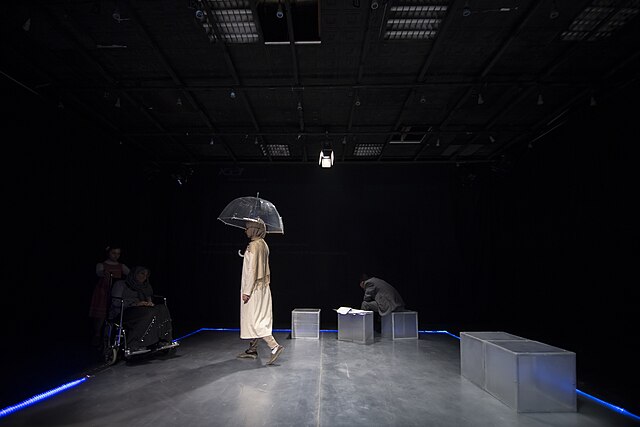

Performance is an activity anyone can enjoy, whether that be in theatre or in film. I have been actively involved with theatre since I was in seventh grade, and I am a Performance and Storytelling minor at Kutztown University. This year, I also directed a play at the local elementary school entitled “Frog and Toad” for my Production and Performance for Young Audience course, so we followed a similar step process to introduce young children into the world of theatrical performances.
These steps should help you learn how to perform properly if you are a beginner!
Before we begin: I recommend having a partner with you to help you prepare, even if your performance is going to be a monologue. A partner can help you with warming up, give you feedback on how you are performing, read lines or give you your lines if you forgot them, and help you become more comfortable performing in front of others. They do not have to be experienced in theatre to help you!
Step 1: Stretch out your body!
It’s important to move our bodies in theatre, which means it’s important to stretch out your muscles to be able to move more smoothly much like an athlete.
One method you can do for this is the Rag Doll Exercise.
- Stand up with your feet shoulder-width apart.
- Drop your arms down to dangle above your feet like a rag doll.
- Dangle your arms there for a few moments to stretch out your back and arms
- Then very slowly move your body back up to the regular position.
You can also do regular pre-gym workout stretches because it is important to work out any muscle for moving your body on stage.
Step 2: Warm Up with some Theatre Games!
Theatre games can help practice improvisation, projection, creativity, and acting. Work with a partner or a group to have the most fun playing them. While there is many you can look up online, I recommend doing this theatre game for practicing projection:
With your partner, pick one or more of the following scenarios to act out. You and your partner want to be loud enough to hear each other in these scenarios if they were real. Creatively make up, or improvise, the conversations:
- A person on a large boat asking for directions from a person on a small boat on the sea.
- A person lost in an underground, dark tunnel trying to find the other person(s).
- Two people in a blizzard trying to find shelter and food.
- A person in an upstairs window trying to talk to a friend(s) below across the street.
- People at a rock concert trying to talk to each other.
- People who are very hard of hearing trying to catch up with each other after not seeing each other for a long time.
Step 3: Know and Understand what you’re going to perform.
How to Understand the Story – Questions to ask and decide on:
- Who is your character? How would they talk? How would they move? What is their backstory?
- If there are other characters, what are your dynamics with these other characters supposed to be like?
- What does the story mean?
- Look up any words in the script you might be unfamiliar with. What do they mean when your character says them?
- How does your character change? What should this change look like?
Step 4: Decide how you’re going to perform it
With theatre, especially if your character has a monologue, you can perform it like an epic grand speech, a solo conversation with someone, or a conversation to yourself. Try it a few different ways: with some ways standing, sitting, or moving around. Ask your partner or group which way they prefer. Scripts often come with stage directions, but in theatre, you do not have to follow the way the playwright wrote them especially considering the space and stage you have to utilize.
Step 5: Practice Memorization
Practice performing it with the paper out loud several times every day, and then try memorizing sections of the monologue. Try to do what you can remember without the paper, and check if need be. Practice every day for at least a few minutes. Your partner can read you lines if you forget to keep you on track. If you forget what the exact line is, remember what is happening in the story so you can continue the show without needing to know the exact line. The audience will not know if you have to deviate from the script.
Step 6: Prepare any materials for performance: Costumes and Props or Lack Thereof
Theatre does not have to be ultra-realistic, so you can perform in regular clothing or without any props or you can add these elements to add more spectacle. Now is the time to decide if you are going to incorporate any of these elements.
If you are:
If you’re looking to use props or costumes, it is easy to DIY the items. If you have the budget to buy exact items, that is great, but you can also use anything you have around you. A black theatre box can become a bench or a bed or even a sewer drain. A string from a all of yarn can become jump rope. Costumes can be made from clothes you wear or purchased more specifically. Think to yourself what would make sense for the character to wear. Once you have these items, practice your performance with the use of props and in your costume when you have it memorized.
If you are not using props or costumes:
If you’re not going to use props, or if certain props aren’t accessible for you to get, you could practice pantomiming these actions. Pantomiming means to express or represent by miming something not there.
If you are going to pantomime, think about how you use these props in real life. Try to exaggerate the movements to make it obvious what object you would be using. You can practice these movements by having your partner trying to guess what you’re pantomiming, and that can help you decide if what you are miming works for the audience to understand.
Now that you have either a plan to pantomime, or a plan to use props or costumes, practice your performance with the clothing on or with the items or with the movements. These materials or changes to movement can feel unnatural to how you would naturally move so it is important to practice the performance with these elements after you memorized the play, musical, or monologue and memorize the use of these tools.
Step 7: Perform It!
Once you’ve decided on how you’re going to perform and have it memorized, perform it for your audience. It’s understandable to be nervous, so keep in mind if you make a mistake to just keep going and know your story well enough to keep it going in case you forget the exact line. Don’t try to go back and restart. Instead, keep the show going.
This article was written for my Technical Writing and Communications course for my instructions assignment.
Appendix
Section A
The Secret Mirror: A Collage Play by Joyce Carol Oates
The WIFE to the Great Man, fifties, attractive, self-effacing, has some secrets of her own to share.
SCENE
A photo-op for her husband, the Great Man.
TIME
Now.
WIFE
[Steps out from beside her famous spouse, abandons her supportive pose, to audience.}
You all know me—though maybe not my name or face. I’m the wife of the Great Man. Oh, I’ve been the Great Man’s wife for years, I’ve hovered here in the background for years. Naturally, I’m not his first wife, or even his second—they’re ancient history.
[Pause.]
I’m never jealous, I’m beyond that. You could say I’m happy, just hovering. And waiting.
[Pause.]
I have a secret.
[She returns to being the WIFE, gives her husband a devoted look while he speaks, then turns back to the audience.]
He basks in my loving attention—he always has. That’s how I won him, thirty years ago. I loved him then, for a while. He doesn’t see me but he sees the love shining in my eyes, that’s enough for him. He sees how completely dependent I am upon him, like a plant needing the sun. He thinks he sees. My secret is—
[She smiles lovingly at her husband, then speaks again to the audience.]
I loathe him. He doesn’t know how I’m hovering waiting for harm—hurt—sorrow— humiliation—oh, any kind of horror!—to befall him. Of course he’s unfaithful to me. I know. I’ve always known, from the first. And I know that—thinking me hopelessly stupid —he doesn’t know I know.
[She smiles.]
Yes—I’m faithful to him. A sign in his eyes of my lack of imagination, my “feminine” weakness. Really it’s because men don’t interest me much. They never did, to tell the truth.
My secret is a simple one: I’m the Great Man’s wife so that I can outlive him.
[She returns to her supportive role, joining unseen others in clapping politely for her husband, then turns back to the audience.]
You’ve noticed—everyone has, and biographers will comment on it—how my face lights up in his presence. My eyes—oh, my eyes shine like a young girl’s! I repay sarcasm with sweetness, rudeness with gentleness, coarseness with delicacy.
A few of the Great Man’s closest friends have guessed my secret, it’s true, but they can’t—and they will never—know.
[She feigns concern for the Great Man, helping to lower him into a reclining chair and puts a blanket over his legs; then she sits beside him with an air of satisfaction.]
Ah—already I’m settling into a comfortable perch at his bedside! It’s morning in this nameless white place and the old fool is blind maybe, or deaf, or both, the thing that’s devouring him has made his “manhood” an old joke, or was it a stroke that hit him?—like the blow of an ax I didn’t wield—not I!
[She hurries to fetch the mail, returning with a dozen or more envelopes. She sits, opening the envelopes with pleasure.]
Best of all, I love reading his mail—our mail. He’s popular and his popularity will continue after his death.
[Opens a letter, scans it quickly.]
Letters from total strangers, letters from old friends—
[She tosses that letter aside, opens another.]
Old lovers—
[She crumples that letter, tosses it aside, opens another.]
Begging letters, homage letters, letters from students, letters from would-be parasites whose ambition—too late!—is to meet the Great Man and to attach their empty lives to his, hoping to kindle a need in him for their adoration, hoping to burrow into his life, hoping even to marry him—outlive him—become his widow. Too late.

 Adventures of Jessi Walker