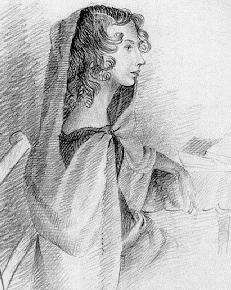
Drawing in pencil by Charlotte Brontë, 1845, Public domain, via Wikimedia Commons
Anne Brontë’s writing was shockingly revolutionary for the time period. She covered many bold themes that at the time were incredibly taboo, and still considered taboo in some aspects today, in her works. The Tenant of Wildfell Hall was considered so shocking that her own sister tried to refuse having it published after her death, leading it to become the most slept on Brontë novel of the three.
Part of that shocking nature was the raw and real feminist aspects included in the novel. Her novel could be considered one of the first truly feminist novels written because of the awareness she spreads through the character of Helen’s trials, the empowerment through Helen’s heroine’s journey, and overall expression of womanhood featured in the novel.
Anne Brontë’s set out to be a head turner, and she succeeded in her writing to encapsulate the female experience in ways that are still contemporary today.
Anne Brontë spreads awareness on the realities of domestic violence through the extremely realistic portrayal of this abuse and the impacts it has on Helen. As an author, she is incredibly gifted at writing realistic characters of both genders. Helen is a genius example of this. Helen feels like the perfect symbol of a victim of domestic violence based off signs of her mentality towards the abuse.
It can be frustrating for a reader who hasn’t experienced abuse to see how Helen constantly makes excuses for Arthur or downplays what is happening to her. However, it is common for abuse victims to do this. This is why abuse can be so hard to escape from as a victim because it can be hard to escape from this mentality.
At one point Helen really loved Arthur and she is seeing him for much of the book through rose-tinted glasses. The period makes this rose-tinted thinking even more prevalent because women during Helen’s time weren’t typically able to leave at all because of how imprisoning marriage was in their society. It was necessary for her survival for Helen to ignore red flags.
One example that comes to mind is that Helen constantly thinks that he won’t be as hurtful to her as Arthur is with his servants or dog because Arthur “is gentle and kind to me” (Brontë 225). Helen is also convinced both before and during their marriage that she can save him from his vices and bad upbringing. It is common for abuse victims to hold out hope that their abusers can change and will keep their promises to become better and won’t hurt them the same way as others because of the love, especially since the victim is usually manipulated so well into thinking this.
In the novel, Arthur is constantly trying to make it up to Helen by promising to change. In one part, Helen is convinced he changed and feels more love for him than ever. In that same short time, she discovers Arthur has been cheating and despises Helen. Brontë brilliantly characterized the mentality of the abuse through Helen.
She also brilliantly added to the plot how devastating and degrading abuse can be to the victim with what happens to Helen from Arthur’s actions. Helen feels so miserable in the home that she has thoughts that hint at suicide like “I am weary of this life” but cannot because of her child (Brontë 325). Her only hope now is to escape on her own since her husband won’t grant her freedom.
When Helen is trying to escape, Arthur destroys her paintings and tools to paint. Painting is akin to the only voice Helen has throughout the novel, and it is so deeply personal to destroy someone’s art. Her painting was also her tool for escape. When he finds out she is going to escape, destroying her tools entraps Helen to Arthur. Brontë wrote this scene brutally which brings awareness to the horrible impact of abuse of how disgusting it can be.
Besides spreading awareness to abuse, Brontë takes it a step further by taking the oppression of Helen and turning it into a story of empowerment. This is extremely brave of Brontë for the time period because most stories of women leaving their husbands served as cautionary tales. However, Helen manages to escape from Arthur. She moves into Wildfell Hall with her son and makes a living for herself.
This is a shocking action for a character to make because women at this time period living alone with their children was an anomaly to happen. Helen can sell her paintings in London to make her living, and her brother Lawrence is shockingly helpful by assisting in her escape. She is a remarkably brave character that upholds such strong boundaries as well.
Gilbert finds out how she got to Wildfell Hall from the beginning of the novel, and he is surprisingly on her side considering how men at the time were. She leaves Wildfell Hall and goes back to Arthur to take care of him on his death bed, but eventually she and Gilbert marry. This is such a sweet ending that empowers the abused victim for escaping rather than punishing her for it.
This is remarkably feminist of Brontë to empower Helen for escaping her marriage and giving her a beautiful love story with Gilbert. Helen herself says it best to summarize what happened to her. She compares herself to a rose by saying a rose is “not as fragrant as a summer flower” and has harsh hardships like “the cold rain” and the “bleak winds,” but that she is just as “fresh and blooming” (Brontë 482).
Abuse victims often feel a level of dirtiness, ruin, or blemish from abuse and in the 19th century this would be a society validated feeling. Brontë flips this stigma though by having Helen express this empowerment with such a beautiful analogy between Helen and the rose that makes the novel feminist without a doubt.
Stepping back from Helen, Brontë beautifully highlights the realities of womanhood in the novel. Many of the female characters also present in the novel have moments to showcase what life is like for these women. A beautiful example is Esther.
Helen helps empower Esther to stick up for what she wants in a marriage and not to just crumble to Esther’s mother’s expectations. Esther is pressured into marrying someone of good status by her family, but she is encouraged by Helen to not faulter. Esther is also rewarded by marrying someone viewed as a good character, Helen’s own brother Lawrence, for this rebellion instead of punished for not marrying someone with an acceptable enough status.
This could be viewed as shocking as it wasn’t expected to marry for love in the time period. Insisting a character should marry for love is quite rebellious and feminist for the women.
Other character’s also have moments that highlight a struggle for women during the novel. Gilbert’s own sister Rose also calls out the unfairness over her expected servitude for Gilbert. She calls out how her mother expects her to follow two common principles women have for the era. One of these principles is that Rose should consider “what’s most agreeable to the gentleman of the house—anything will do for the ladies” and Rose tries to protest this policy (Brontë 57).
It is not a huge act of feminism, but tiny moments like this add to the overall feminist feeling of the novel. These women all feel very real and their struggles feel so seen by such moments with other characters in the novel.
Feminism is very prevalent in The Tenant of Wildfell Hall. It is so overwhelmingly feminist that these topics still come up in contemporary times today, as Brontë showcased the truths of womanhood so realistically through Helen’s journey and the other characters present within the novel.
This novel feels like Anne Brontë was trying to hold a mirror up to society. This mirror both showcased the problems but also could have given hope for the women reading it if it were able to be published properly. She wrote a novel with feminism with such beautiful dedication and thought put into every character, word, and plot line that makes it so revolutionary.

 Adventures of Jessi Walker
One thought on “Awareness, Empowerment, and Womanhood in The Tenant of Wildfell Hall”