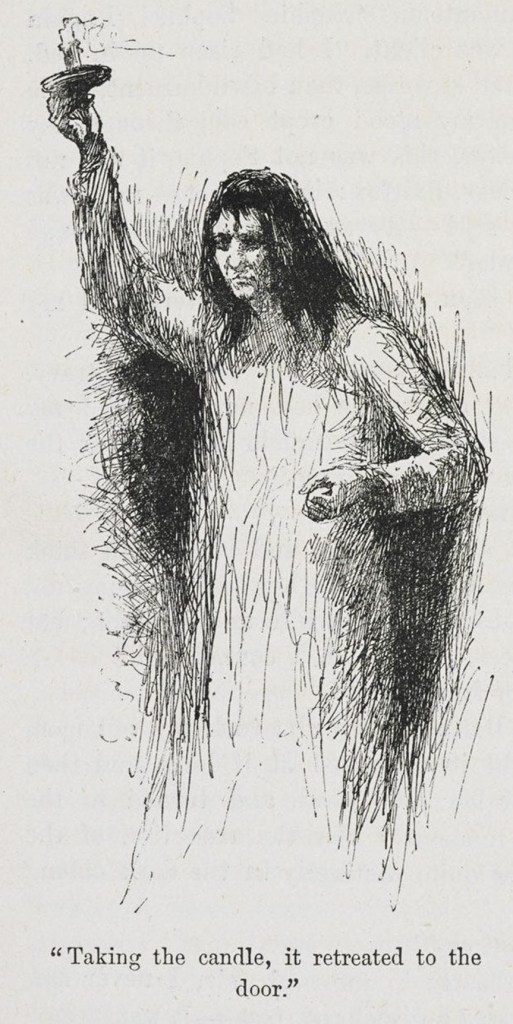
Edmund H. Garrett, Public domain, via Wikimedia Commons
Jane Eyre focuses a lot on the traps society has in place for the characters in the novel. Jane, the titular character, is at first trapped into the power imbalance children were treated in society, as well as the trap of being an orphan with seemingly no prospects. She is trapped in her own fears from being treated so cruelly as a child by Mrs. Reed and by the head of Lowood. She is next in the trap of servitude once she starts to free herself from the influences of Mrs. Reed’s words. First she is trapped from teaching at Lowood after spending the majority of her childhood and second to serving as governess for Mr. Rochester’s illegitimate daughter at Thornfield Hall.
However Mr. Rochester, her employer, is in a trap himself: the trap of the promise of ever after.
He was trapped initially and directly due to his naivety. He was a victim of blindly trusting the arranged marriage his family and Bertha’s family set out for them. Mr. Rochester’s family could only think of the thousand-pound gain from the marriage, and Bertha’s family could be free of the shame of hiding her away themselves like they are burdened to have for her mother in the asylum.
His father and Mr. Mason tempted him to agree to this arrangement because Bertha was “the boast of Spanish Town for her beauty” and the novelties of gaining money in the West India (Brontë 297). He met her under controlled conditions, as he was never alone with her, and she was able to be coached to charm Mr. Rochester. He was naïve and blind, so he married her without questioning this. Once they were married, he realized how Bertha was suffering from her mental health and considered mad. He was blind to how manipulated he was being, and it feels symbolic at the end of the book that “he is stone blind” following the death of Bertha and the fire in his home as well (Brontë 417).
Mr. Rochester struggles with his naivety throughout the novel and still seemed to learn his lesson on how to handle these complex relationship dynamics appropriately. He was a fool when it came to how to handle Bertha while showing interest in Jane, thinking he could also pull a similar trick on Jane.
A part of his character trait is that he has a lot to learn and makes foolish, rash choices and schemes and has to learn the consequences. Mr. Rochester losing his vision is an impactful choice Charlotte Brontë made to showcase the trap his marriage ended up putting him in considering he blindly entered a marriage with Bertha Mason and to give him that consequence physically.
Outside being led blind and eventually literally becoming blind from the initial trick pulled on him, Mr. Rochester is also imprisoned directly by society. He doesn’t have many options on what to do when it comes to Bertha.
He could send her away to the asylum and be done with her more officially, but morally it would be horrible to do to her considering the cruel and torturous environments insane asylums were back then. It felt right to keep her upstairs, with an assistant that can handle her like Grace Pool. While it is not right she is tied up, society at the time didn’t give him good options for how to handle her illness. There was no psychotherapy, no anti-psychotics or other mental health medication, and no understanding of what being “mad” actually is.
He felt responsible for keeping her under her roof instead of being tortured in an asylum even though he had no resources to properly help her either. Society imprisoned both Bertha and Mr. Rochester by the taboo nature of how mental health was handled in the Victorian Era. He couldn’t divorce her easily because society considered Bertha “a part of me” and the doctor’s discovering her madness made it more complicated for him to “rid myself of it by any legal proceedings” (Brontë 298). Even if she tried to kill her own brother, set fire to Mr. Rochester himself, and lashed out at Mr. Rochester, he could not be free from her if he didn’t want her tortured in an asylum. Bertha is lashing out due to her severe struggles of mental health and her lack of resources to seek help, but it is still a stressful and dangerous situation Mr. Rochester must live so near to.
He has to put up with her abuse, even if it is caused by her severe mental illness and the poor treatment she is receiving due to the lack of research of mental health. He is still being regularly harmed because of this sacrifice to not just put her away as that was his only other option. This is because of the institutions of their marriage stipulating them to stay together. He also was caught at the altar by Bertha Mason’s brother while he was trying to marry Jane Eyre. Mr. Mason testifying that his sister was alive and married to Mr. Rochester made it impossible for him to move on to another in spite of Bertha’s extreme suffering.
Mr. Rochester’s image is also trapped by his marriage to Bertha, especially in Jane Eyre’s eyes when it is finally revealed he has a wife and the strange happenings at Thornfield Hall are due to her and not his servant Grace Pool. He is also trapped in his own insecurity.
He feels the need to pull stunts like talking to Blanche and Jane in the gypsy costume because he has been burned by the pursuit of greed before. Blanche revokes her interest in marrying him once the gypsy suggests he isn’t as rich as he says he is, which proves his point. With Jane, he wants to check her intentions as well because he is worried about being stuck in a marriage that is a business contract once again. He has seen the ugly side of that. Doing these stunts though for his insecurities ended up ruining him as well though like not telling Jane the truth. He didn’t tell Jane about Bertha, and Jane cannot put her own morals aside to run off with him and get married to him unofficially. She points out how cruel Mr. Rochester speaks about Bertha. Until they reconcile she feels so terrible and used after her wedding was ruined by the exposure of Bertha.
All of his actions ended up costing him his true love with Jane.
She runs off in the middle of the night in a direction as far away as possible to try to avoid the severe pain Mr. Rochester caused her. He was just trying to keep his secret, but his secret burned him and burned the idea of him and Jane for a long time. He was seen as just the rake he appeared to be from his times in Paris and the man that Mrs. Fairfax tried to warn her about. It almost permanently cost him his shot at true companionship he was seeking for throughout the novel.
The marriage with Bertha delaying his happiness for so long imprisoned him, even if it was largely Mr. Rochester’s fault in part for keeping it so hidden from Jane and not being upfront about it.
Mr. Rochester was an interesting character to follow and a hard one to figure out. He paid the ultimate price for his naivety by losing Jane for so long and by going blind like the blind fool he was in the beginning of his communications with Bertha.
He was an example of what a trap in a marriage could look like for men, much like how The Tenant of Wildfell Hall showed how the trap of marriage for women could be through the character of Helen Graham and her story of domestic violence and alcoholism.
Mr. Rochester is a perfect figure of an example of how “Ever After,” especially under such rushed and blind decisions, could prevent true happiness in society and romance.

 Adventures of Jessi Walker